






Choosing a CRM service provider in the UAE matters as much as choosing the platform. For a growing real estate company, no single provider is best for everyone. The right one knows your chosen platform, can show UAE references in your sector and connects the CRM to your finance system. This guide compares the platforms UAE businesses shortlist and gives you a 10-criterion scorecard you can copy into an RFP. It also sets out a rollout checklist you can hold any provider to.
Quick answer: A CRM service provider in the UAE is the partner that plans, configures, migrates data into, integrates and supports a CRM platform such as Dynamics 365, Salesforce, Zoho CRM or HubSpot. To choose one, match the platform to your ERP, team and industry. Then score each provider on UAE references, integration depth, data migration method, Arabic support, compliance knowledge and post-go-live support.
Tech& is a Microsoft partner in Dubai Airport Freezone with 20+ years of industry experience across the UAE and GCC.
What is a CRM service provider in the UAE, and how do you choose the right one?
A CRM vendor builds the software and sells the licences. A CRM service provider, often called an implementation partner, turns that software into a working system. It runs discovery, configuration, data migration, integration with your ERP and email, user training and support after go-live. You buy the product from one and the outcome from the other.
Customer relationship management means one shared record for every customer, contact, deal and service request. That record replaces the spreadsheets, personal inboxes and WhatsApp threads where customer data usually sits before a CRM project starts. For a fuller view of the customer side, see what a CRM does for your customers.
A provider typically configures three areas:
- Sales: lead management from web forms, email and events, an opportunity pipeline by stage and owner, lead scoring, and sales automation such as guided call and email sequences.
- Customer service: cases that each get an owner, a priority and a service-level timer, from the first email to resolution.
- The link to invoicing: quotes and orders pass to the ERP, which normally issues the invoice.
The same CRM software can succeed in one company and fail in another. The difference is usually the quality of discovery, the state of the migrated data and whether people use the system after go-live. Searches for the best CRM software or a CRM in Dubai tend to return product lists. A shortlist built only on product features misses the part of the project that carries most of the risk.
What is the difference between a CRM vendor and a CRM implementation partner?
The vendor owns the product, its roadmap and the licence terms. The partner owns your configuration, your migrated data, your integrations and your support after go-live. In the UAE most enterprise buyers work with a local partner, because the vendor rarely configures the system or trains your teams itself.
You can buy licences directly from some vendors. You then carry the design, migration and integration work yourself, or hire someone to do it later. For a team with a simple pipeline and no ERP link, that can work. For a mid-size business connecting sales to finance, it usually moves the risk rather than removing it.
Who is the best CRM service provider in the UAE?
No single provider is best for every business. The best CRM service provider for you knows your chosen platform and can show references in your sector in the UAE or GCC. It has a written data migration method, connects the CRM to your ERP, supports Arabic and puts post-go-live support terms in writing before you sign.
The scorecard further down turns these points into criteria you can score with evidence rather than impressions.
Which CRM platforms do UAE businesses shortlist, and who does each suit?
Most UAE shortlists include Microsoft Dynamics 365 Sales and Customer Service, Salesforce, Zoho CRM, HubSpot, Odoo and Bitrix24, plus specialist industry CRMs. The right choice depends on the ERP you run, how complex your processes are and the partner who will support the platform locally. The table below shows who each option tends to suit and what to check.
| Platform | Tends to suit | ERP connection to check | Local fit to confirm in a demo | Question for the provider |
| Bitrix24 | Teams that want CRM alongside internal collaboration tools | How deals and invoices reach your accounting or ERP system | Arabic interface, WhatsApp channel, AED quotes | Which parts of the suite will you configure, and which are left to us? |
| HubSpot | Marketing-led teams with an inbound pipeline | Whether a connector exists for your ERP and who maintains it | Arabic content in emails and forms, WhatsApp logging | How will quotes and orders reach finance without re-keying? |
| Microsoft Dynamics 365 Sales and Customer Service | Companies on Business Central, Finance and Operations, Outlook and Teams | Quote-to-order-to-invoice flow with the Microsoft ERP | Arabic and right-to-left forms, WhatsApp connector, Power BI reports | Which applications do we need now, and which can wait? |
| Odoo | Companies that want CRM and ERP from one suite | Whether you would replace your current ERP or connect to it | Arabic interface and printed documents, AED and multi-currency | Is the CRM module enough on its own, or does it assume Odoo ERP? |
| Salesforce | Organisations wanting a broad CRM ecosystem and add-on apps | The integration layer to a non-Salesforce ERP, and its upkeep | Arabic data, WhatsApp logging, regional support hours | Who maintains the integration after go-live, and at what cost? |
| Zoho CRM | Growing teams wanting a lighter platform within a wider app suite | Connection to Zoho's own finance apps or to your existing ERP | Arabic interface, WhatsApp channel, AED quotes | How do you handle multiple entities and approval workflows? |
| Specialist industry CRMs, such as property CRMs | Firms whose sales model is specific, for example listings and portal leads | Whether finance data flows to the ERP or stays in the CRM | Portal integrations, Arabic listings, WhatsApp | What happens to our data and integrations if we outgrow the product? |
How this comparison was made
Platforms are listed alphabetically, with specialist CRMs last, and none is ranked first. Each column holds criteria you can check yourself in a demo or a written answer. There are no market-share, price or feature claims. Tech& is a Microsoft partner, so read the Dynamics 365 row with that in mind and test it as hard as the others.
Is Zoho, HubSpot, Salesforce or Dynamics 365 better for UAE businesses?
Each suits a different situation. Dynamics 365 fits companies that run Microsoft ERP, Outlook and Teams. Salesforce suits organisations that want a broad CRM ecosystem. Zoho CRM and HubSpot are often shortlisted for lighter, marketing-led pipelines. Start from your ERP, your processes and the local partner who will support the platform, not from the brand.
When is Dynamics 365 not the right answer?
Dynamics 365 is not the right answer for every team. A team with one simple pipeline, no Microsoft ERP and no plan to connect sales to finance may be better served by a lighter platform. Paying for depth you will not use raises licence and support costs without improving results.
Is CRM software available on the cloud, and can it be customised?
Yes. The platforms in the table are sold as cloud services, and all can be configured to your stages, fields and approval rules. Customisation is a trade-off. Every custom build adds testing, support and upgrade effort, so use standard features first and customise only where a process gives you a real advantage.
Ask each vendor which cloud region holds your data. Confirm any sector obligations, such as those in banking and financial services, with your own compliance team before you sign.
How do you choose the right CRM platform for your ERP, team and industry?
Start from the system that holds your financial data. If you run Business Central or Finance and Operations, Dynamics 365 keeps quotes, orders and invoices on one Microsoft data platform. If you run another ERP, weigh the cost and reliability of the integration before you compare CRM features, because the integration outlasts any demo.
If you already run Business Central or Finance and Operations
Dynamics 365 Sales works alongside Outlook, Teams and Excel, with reports in Power BI and Excel. Accepted quotes can become orders in the ERP, so sales teams see order and payment status without asking finance. Check Copilot features in a demo against a real task, such as summarising an account before a renewal call.
If your ERP is not Microsoft, or you have none yet
Compare the integration the partner will build and maintain, not only the CRM licence. A cheaper CRM licence can cost more over time if every price change needs manual updates in two systems. If you have no ERP yet, decide on the finance system first or at the same time. Choosing the CRM alone fixes your integration path early.
Can a CRM connect to WhatsApp and to my ERP in the UAE?
Yes, most major platforms can connect to both, but how deep the connection goes varies. Ask how WhatsApp conversations are logged on the customer record and who maintains the connector. Check whether quotes and orders flow into your ERP with the correct customer and tax data. With a Microsoft ERP, Dynamics 365 keeps this on one platform.
This matters most for enquiry-led sales teams. If conversations stay on personal phones, managers cannot see the pipeline. The business also loses the history when a salesperson leaves.
Does the CRM support Arabic and right-to-left text?
Arabic support varies by platform and by what you need from it. Check four things separately: the interface language, right-to-left layout, Arabic data in names and addresses, and Arabic on printed quotes. Test all four in a demo with your own records rather than accepting a general yes in a proposal.
Industry also changes the rule. Banking and financial services usually need audit trails and tight access control. Trading and manufacturing usually need quote-to-order-to-invoice links to stock and pricing. Small businesses with one simple pipeline need less scope, and a good partner should say so.
Does a growing real estate company need a specialist property CRM?
Not always. Brokerages focused on listings and portal leads often choose a specialist property CRM. Developers that also need sales contracts, collections and project costs connected to finance should also test general platforms such as Dynamics 365 or Salesforce with a capable partner. For a developer, the ERP connection usually matters more than listing features.
Which CRM implementation partners suit UAE real estate developers and brokerages in 2026?
The partners that suit UAE real estate developers and brokerages in 2026 work on the platform you have chosen. That platform could be Salesforce, Zoho CRM, Dynamics 365 or a specialist property CRM. A suitable partner can show UAE property references and explain how leads, bookings and collections reach your finance system. Judge partners on that evidence, not on a ranking.
Real estate buyers often shortlist the platform first and the partner second. Reverse the order once two or three platforms remain, because the partner decides how well the platform fits your sales model.
| Business type | What the partner must handle | Evidence to ask for |
| Brokerage | Portal and website lead capture, agent assignment, WhatsApp logging, commission tracking | A demo with live portal leads, plus a reference from another UAE brokerage |
| Developer selling off-plan | Unit inventory, reservations, sales contracts, payment plans and collections linked to finance | A walkthrough from reservation to receipt in the ERP, using your payment plan |
| Developer with leasing or a large customer base after handover | Service requests, renewals and handover cases on the same customer record | How customer service cases link to the original sale and the finance account |
Apply the scorecard in the next section to every partner on the list, including any that sell a property CRM of their own.
How to score a CRM service provider: a 10-criterion scorecard
Copy this table into your RFP and ask every provider for written evidence on each line.
| # | Criterion | Priority | Evidence to ask for |
| 1 | Vendor partner status and current designation | High | The partner's listing on the vendor's own directory and the designations it holds today |
| 2 | UAE and GCC references in your sector | High | Two or three references you can call, of similar size, with what went live |
| 3 | Discovery and gap-fit method | High | A sample gap-fit showing which needs use standard features, configuration or custom build |
| 4 | Data migration method | High | A written plan sized by custom code, years of history kept, number of integrations and reports to rebuild, with a rehearsal |
| 5 | Integration depth | High | Named connectors or APIs for your ERP, Outlook and Teams, WhatsApp and Power BI, and who maintains each |
| 6 | Arabic and right-to-left interface and data | Medium | A demo using Arabic names, addresses and a printed quote from your own data |
| 7 | E-invoicing awareness | Medium | How quotes and orders pass clean customer and tax data to the ERP that issues invoices |
| 8 | Separate Development, Test, UAT and Production environments | Medium | The environment plan and who approves each change between environments |
| 9 | Post-go-live support | High | Support hours, response targets by severity, the escalation route and named contacts, in the contract |
| 10 | Multi-entity and GCC rollout | Medium | Experience with several entities, currencies and languages, for example a second entity in Saudi Arabia |
Row 4 uses four drivers that set migration effort: the volume of custom code, the years of history you keep, the number of integrations and the reports you rebuild. A provider that sizes migration by record count alone will underestimate the work.
Row 7 matters because CRM quotes feed ERP invoices. Businesses whose revenue is equal to or exceeds AED 50,000,000 had to appoint an Accredited Service Provider by 30 October 2026. That deadline has passed. They must implement the Electronic Invoicing System by 1 January 2027 (source). Businesses below AED 50,000,000 appoint one by 31 March 2027 and implement by 1 July 2027 (source). If customer names, tax numbers or addresses are wrong in the CRM, the error travels to the invoice. For the finance side, see Peppol e-invoicing software features for UAE CFOs.
Which criteria carry the most weight?
The six High rows carry the most weight, because they decide whether the system goes live correctly and stays in use. These are partner status, references, gap-fit, migration, integration and support. A simple method is to score each row from 0 to 3 on the evidence supplied, then double the score for High rows.
Score the written evidence, not the presentation. A polished demo built on sample data says little about how your own records will migrate.
What are the red flags when comparing CRM providers?
Four signs predict trouble after you sign, and each has a cost:
- No named references: you cannot check delivery, so you take the risk on trust.
- No migration rehearsal: data problems surface on go-live day, when users first lose confidence in the system.
- No written support terms: the partner can step back after go-live.
- Licences and services in one figure: you cannot compare quotes or see where costs sit.
What drives the cost of a CRM project in the UAE?
CRM cost has two parts. The first is recurring licences, usually priced per user per month and by edition. The second is one-off services covering discovery, configuration, data migration, integration and training. Ongoing support or managed services come on top. The number of users, integrations and customisations moves the total most.
Most platforms sell editions from entry level to enterprise. Compare what each edition includes, such as sales automation, AI and Copilot features and service modules, rather than the headline price per seat.
Which choices raise or lower the total cost?
These choices raise cost:
- heavy customisation instead of standard features
- many integrations, each needing build, testing and upkeep
- keeping many years of history in the new system
- rebuilding a large set of reports
- rolling out across several entities or GCC countries at once
These choices lower risk:
- a phased rollout, starting with one team or entity
- standard features first, with customisation added once users have settled in
- a migration rehearsal before go-live
What should an itemised CRM quote include?
An itemised quote should be in AED and separate licences, services and support. It should show VAT on its own line and state what support covers after go-live. Check the current VAT rule on tax.gov.ae rather than relying on a figure in a proposal. A quote that bundles everything into one number cannot be compared like for like.
Ask each provider to name the assumptions behind its services estimate. Typical assumptions are the number of users, integrations, migrated years and reports. When two quotes differ widely, the gap usually sits in those assumptions.
What does a sound CRM rollout look like, from discovery to go-live?
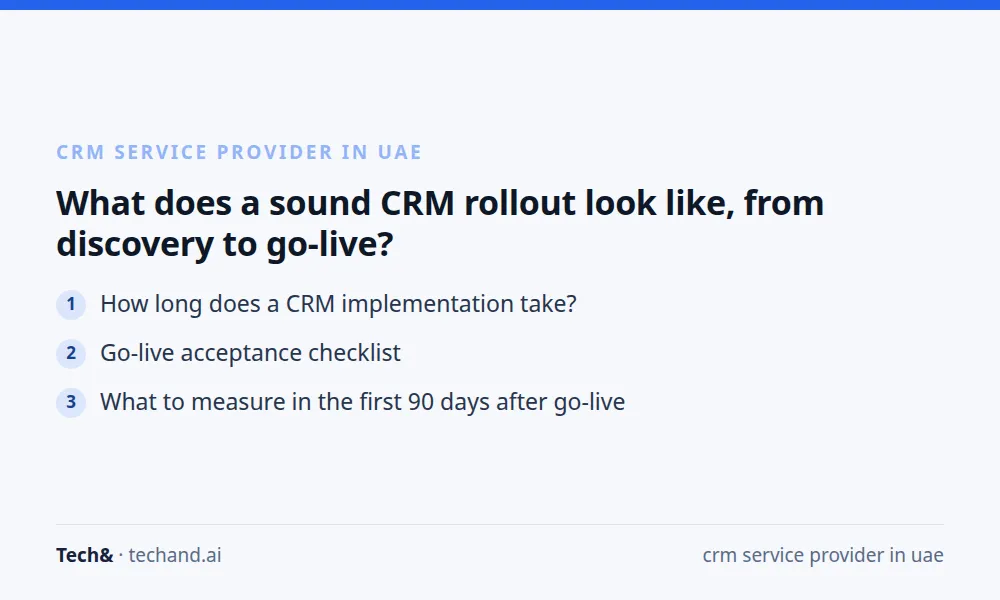
A sound rollout moves through discovery and gap-fit, solution design and a build in a Development environment. Testing and user acceptance testing with real users and data come next, then a migration rehearsal and a controlled go-live. A period of close support follows. Each step should have an owner and written sign-off criteria.
- Discovery and gap-fit: map how sales and service teams work today and mark each need as standard, configuration or custom build.
- Solution design: agree stages, fields, roles and integrations in writing.
- Build in Development: configure the platform without touching live data.
- Test: check each process and integration in a separate Test environment.
- User acceptance testing: key users run real scenarios with real data in UAT and sign off.
- Migration rehearsal: load the full data set once, reconcile it and fix the gaps.
- Go-live in Production: move to the live environment on an agreed date with a rollback plan.
- Close support: keep the project team available while users settle in.
A regular steering meeting with your sales, service and IT leads keeps decisions, risks and changes visible as the project moves through these stages.
How long does a CRM implementation take?
It depends on scope. The modules you deploy, the number of users and entities, the integrations with your ERP and other business tools, and the volume of data you migrate all set the duration. Ask each provider to show its plan against these drivers, including testing, user acceptance and a migration rehearsal before go-live.
A plan that skips UAT or the rehearsal will look shorter on paper. It usually moves the delay to after go-live, where it costs more.
Go-live acceptance checklist
Do not accept go-live until each item is confirmed:
- data reconciled against the source system
- integrations tested end to end, including quote to ERP order
- roles and access confirmed for every user group
- key users trained and able to train others
- a rollback plan agreed in writing
- a named support contact and escalation route in place
What to measure in the first 90 days after go-live
Track a few measures that show whether the CRM solution is in use:
- the share of deals updated in the CRM rather than in spreadsheets
- the completeness of customer data on new and existing accounts
- case response times against your service levels
- how often managers open the pipeline and Power BI reports
Set your own targets before go-live so you can compare like for like.
Who does the work: Tech& as a Dynamics 365 CRM partner in Dubai
We are a Microsoft partner based in Dubai Airport Freezone in Dubai, UAE, serving teams in Dubai, Abu Dhabi, across the UAE and the wider GCC. We bring 20+ years of industry experience.
We plan, configure and connect Dynamics 365 Sales and Customer Service, with Customer Insights and Field Service available as your needs grow. We connect the CRM to Business Central implementation in the UAE, Dynamics 365 Finance and Operations and Power Platform and Power BI analytics. We also build AI agents with Copilot Studio.
Tech& is an accredited service provider under the Ministry of Finance e-invoicing framework. This matters when CRM quotes feed ERP invoices.
Our sector focus is banking and financial services, trading and manufacturing. We also serve the public sector, hospitality, retail, professional services, non-profit organisations and education. After go-live we offer managed services and post-go-live support to keep your CRM running, and our team provides 24/7 support to the organisations we work with.
If your scorecard points to a platform other than Dynamics 365, the criteria in this guide still apply to whichever partner you choose. Many UAE businesses and businesses in Dubai will reach a different answer, and that is the purpose of a neutral scorecard.
Book a free consultation to test your CRM shortlist
If you are comparing CRM solutions or choosing a CRM service provider in the UAE, bring your shortlist and your completed scorecard. Book a consultation and we will test your shortlist against these criteria. The consultation is free of charge.
About the author: Tech& Technical Team, Microsoft Dynamics 365 and AI Consulting Team
The Tech& Technical Team is a group of Dynamics 365, Power Platform and AI consultants based in Dubai. We help UAE and GCC enterprises implement, migrate and automate ERP, CRM and AI systems with measurable business results.
Microsoft partner. 20+ years of industry experience across banking, public sector, retail, hospitality, manufacturing and more. Delivers Dynamics 365 Business Central, Finance & Operations, CRM, Power Platform and Copilot Studio projects across the UAE and GCC.
Book a free consultation to test your CRM shortlist
Book a consultation and we will test your shortlist against these criteria.
Get in-touch with our ExpertsTech& Technical Team
Microsoft Dynamics 365 and AI Consulting Team